
IFRS 20: Is It Really About Regulatory Assets and Liabilities?

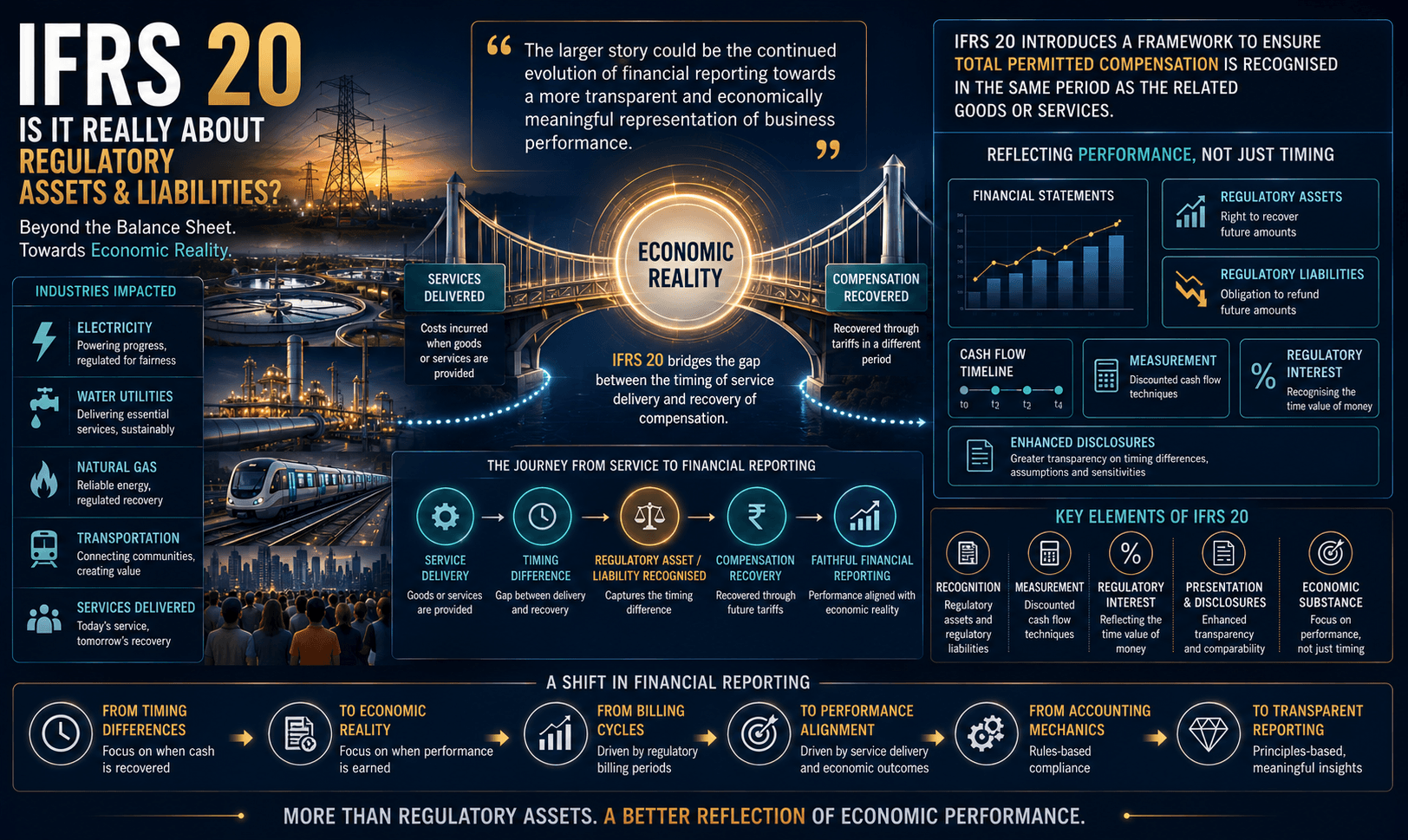
The issuance of IFRS 20, Regulatory Assets and Regulatory Liabilities, marks an important development in financial reporting for entities operating in rate-regulated industries. At first glance, the standard appears to focus on introducing a new framework for recognising regulatory assets and regulatory liabilities. However, a closer look suggests that its broader objective may be something more fundamental.

Financial reporting has increasingly evolved towards reflecting the economic substance of transactions and events rather than merely their legal form or timing. Viewed through this lens, IFRS 20 appears to be another step in that journey.

The Challenge of Timing Differences

Industries such as electricity, water, gas, and transportation often operate under regulatory frameworks that determine when and how costs can be recovered through customer tariffs.

In many cases, there can be a disconnect between the period in which goods or services are delivered and the period in which the related compensation is recovered. As a result, revenue recognised in a particular reporting period may not fully reflect the compensation associated with the services provided during that same period.

This timing mismatch can make it difficult for financial statements to present a complete picture of an entity’s performance.

How IFRS 20 Addresses the Issue

IFRS 20 seeks to bridge this gap by introducing regulatory assets and regulatory liabilities that capture these timing differences.

The objective is to ensure that total permitted compensation is recognised in the same reporting period as the related goods or services. By doing so, the standard aims to improve the alignment between operational performance and financial reporting outcomes.

The technical implications of the standard are significant and include:

  • Recognition of regulatory assets and regulatory liabilities arising from timing differences
  • Measurement using discounted cash flow techniques
  • Recognition of regulatory interest
  • Enhanced presentation and disclosure requirements
  • Replacement of IFRS 14 and the introduction of a more comprehensive reporting framework

For affected entities, these changes will require careful evaluation of existing regulatory arrangements, measurement methodologies, and reporting processes.

Looking Beyond the Technical Requirements

What is particularly interesting about IFRS 20 is the philosophy underpinning the standard.

While the discussion often centres on the introduction of new balance sheet categories, the broader objective appears to be improving how financial performance is represented. The standard seeks to ensure that financial statements more faithfully reflect the economic consequences of providing regulated goods and services, even when billing and cash recovery occur across different reporting periods.

In that sense, regulatory assets and liabilities may be viewed as the mechanism through which a larger objective is achieved, namely, a more accurate representation of financial performance.

This aligns with a broader trend in financial reporting, where accounting standards increasingly focus on presenting economic reality rather than simply recording transactions based on their timing.

Preparing for the Transition

Although IFRS 20 becomes effective for annual reporting periods beginning on or after 1 January 2029, organisations should not underestimate the preparation required.

Identifying timing differences, evaluating enforceable rights and obligations, developing appropriate measurement models, and strengthening data collection processes will all require considerable planning and professional judgment.

For many entities, implementation will involve collaboration across finance, regulatory, operational, and technology functions to ensure a smooth transition.

More Than a New Accounting Standard

IFRS 20 is undoubtedly a technical standard. Yet its significance may extend beyond the creation of regulatory assets and liabilities.

At its core, the standard appears to reinforce a fundamental principle of modern financial reporting: financial statements should reflect economic performance as faithfully as possible, even when commercial, regulatory, and cash flow realities do not align neatly within a reporting period.

The new accounting requirements may attract the headlines, but the larger story could be the continued evolution of financial reporting towards a more transparent and economically meaningful representation of business performance.

Can India Fund Its Five-Trillion-Dollar Ambition? The Infrastructure Finance Question That Matters

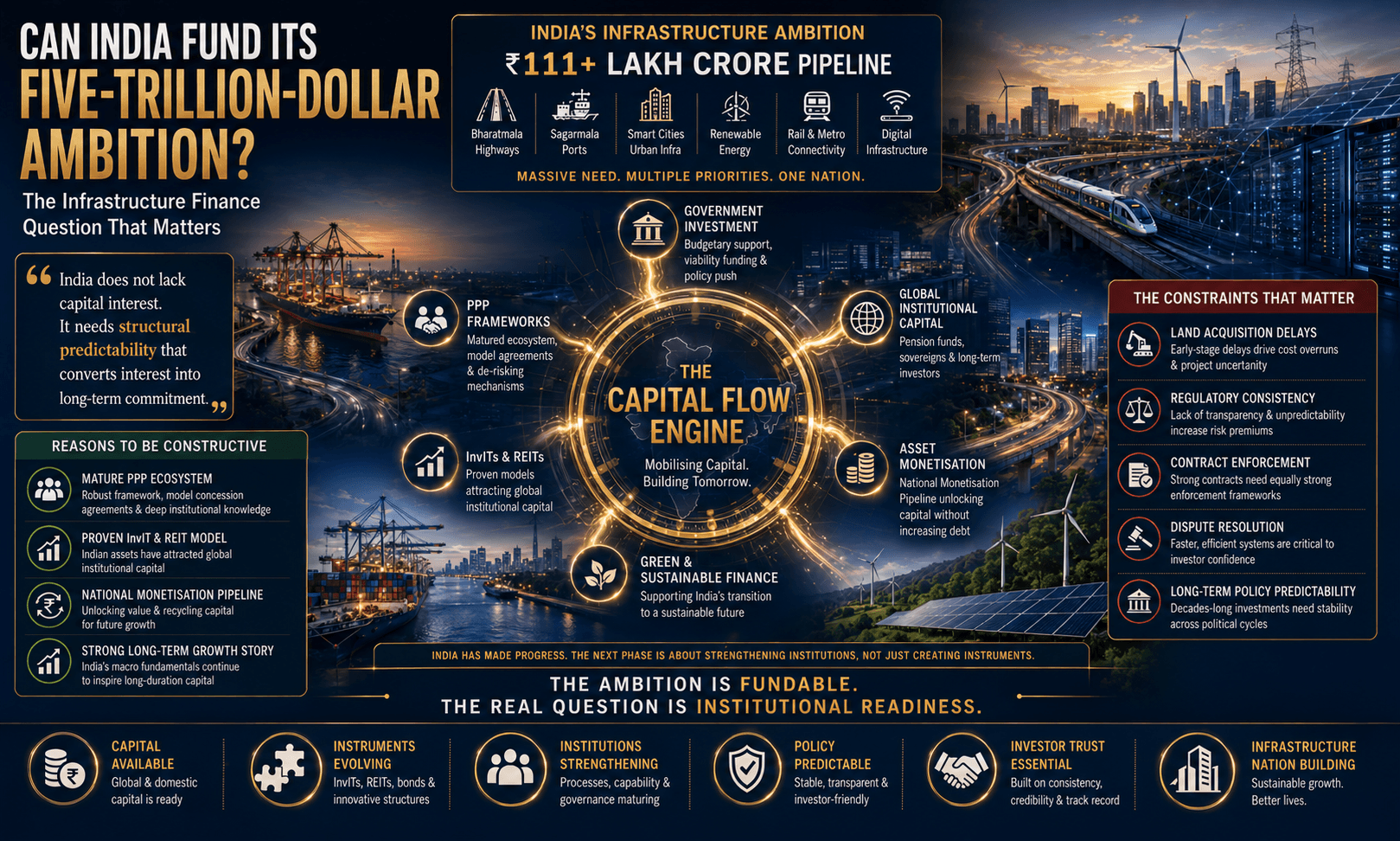
India’s infrastructure ambition is, by any measure, enormous. The National Infrastructure Pipeline alone targets over ₹111 lakh crore in investment. Add to this the Smart Cities Mission, Bharatmala, Sagarmala, and the renewable energy transition, and the capital requirement quickly exceeds what any single source, government, banking system, or capital market, can support on its own.

The question, therefore, is not theoretical. Can this scale of ambition actually be funded?

Reasons to be constructive

There are clear reasons for optimism. The PPP framework has matured significantly. Model concession agreements are in place. Institutional knowledge has deepened over two decades of transactions. This matters more than it appears, because a large part of what deters capital is not just uncertainty of returns, but uncertainty of process.

InvITs and REITs have demonstrated that Indian infrastructure and real estate assets can attract global institutional capital. The proof of concept is now established.

Asset monetisation through the National Monetisation Pipeline is unlocking capital without increasing sovereign borrowing. And India’s long-term growth trajectory continues to appeal to investors willing to take a long-duration view.

The constraints that matter

The challenges, however, are structural. Land acquisition remains one of the most persistent sources of delay and cost escalation. While regulatory safeguards have strengthened, the early stages of project development continue to be slow and unpredictable. Developers have adapted, and investors have priced this in. That does not mean the issue is resolved.

Regulatory consistency is another critical factor. Infrastructure investments are inherently long-term. Capital committed today is based on expectations that extend across decades.

When tariff frameworks lack transparency, or when regulatory decisions appear inconsistent, the impact is immediate. It reflects in higher risk premiums and, in some cases, in capital choosing alternative markets. Contract enforcement and dispute resolution complete the picture. The contracts themselves have become more sophisticated. The systems required to interpret and enforce them must evolve at the same pace.

What the five-trillion ambition requires

India has made meaningful progress in rebuilding its infrastructure financing architecture. The next phase is less about introducing new instruments and more about strengthening the institutional foundations that support them.

India does not lack capital interest. It needs structural predictability that converts interest into long-term commitment.

The ambition is fundable. The more important question is whether the institutional infrastructure can keep pace with the physical infrastructure. 

The Latest Ind AS Amendments Are Changing More Than Accounting Standards

The latest Ind AS amendments may appear technical on the surface, but their implications extend far beyond accounting compliance.

These changes are set to influence how organisations manage debt, monitor financial risks, assess tax exposures, and communicate with investors and lenders. For finance leaders, the focus is shifting from technical interpretation to operational readiness.

While accounting standards are often viewed through a compliance lens, the latest amendments have implications that extend well beyond financial reporting. They influence liquidity management, financing decisions, tax planning, stakeholder communication, and governance practices.

Several developments stand out.

Liability Classification Is No Longer Open to Interpretation

One of the most significant changes relates to the classification of liabilities.

Beginning FY 2026-27, post-reporting date waivers from lenders will no longer influence whether a liability is classified as current or non-current. If an entity does not have the right to defer settlement of an obligation at the reporting date, the liability must be classified as current.

This places complete emphasis on the position that exists as of the balance sheet date rather than management’s expectations or subsequent developments.

For companies with structured debt arrangements, refinancing plans, or covenant-linked borrowings, the impact could be substantial. Reported liquidity positions may look materially different, even when long-term financing discussions are underway.

Covenant Management Must Become Proactive

The amendments also reinforce the importance of covenant monitoring.

Historically, some organisations could address covenant-related concerns through post year-end lender discussions and waivers. That flexibility is becoming increasingly limited. Classification outcomes will now depend on whether covenant requirements have been satisfied at the reporting date.

As a result, covenant compliance can no longer be viewed as a year-end exercise.

Finance leaders will need stronger monitoring mechanisms throughout the year, supported by regular dialogue with lenders and early identification of potential breaches. The objective is no longer simply resolving issues, but preventing them from affecting financial reporting outcomes in the first place.

Global Tax Is Becoming a Financial Reporting Consideration

The introduction of Pillar Two marks another important shift.

Tax is no longer solely a local compliance matter. Indian companies with international operations, as well as subsidiaries of multinational groups, may face tax implications that span multiple jurisdictions.

This creates new challenges around data availability, system readiness, and visibility across global operations. Organisations will need greater coordination between finance, tax, and technology functions to understand potential exposures and ensure accurate reporting.

For many businesses, this may require capabilities that extend well beyond traditional tax compliance frameworks.

Disclosures Are Becoming Strategic Decision Tools

Another notable development is the growing significance of disclosures.

Areas such as supplier finance arrangements, liquidity risk, and financing structures now require more transparent and meaningful reporting. Stakeholders increasingly rely on disclosures to understand the quality of earnings, resilience of cash flows, and the overall financial health of an organisation.

In this environment, the notes to accounts are no longer supplementary information. They are becoming an integral part of the financial story.

Investors, lenders, analysts, and regulators are paying closer attention to what organisations disclose, how they disclose it, and what those disclosures reveal about risk and governance practices.

A Broader Shift in Financial Reporting

Taken together, these amendments signal a larger transformation in financial reporting:

  • From compliance to transparency
    • From flexibility to discipline
    • From reporting outcomes to reporting substance
    • From retrospective assessment to continuous monitoring

The direction of travel is clear. Financial reporting is becoming more reflective of economic reality and less influenced by post-period adjustments or management intent.

The Real Challenge Is Operational Readiness

For most organisations, understanding the amendments will not be the difficult part.

The greater challenge will be ensuring operational readiness. This includes strengthening internal controls, improving covenant monitoring processes, enhancing cross-functional coordination, upgrading reporting systems, and preparing stakeholders for the impact of these changes.

The latest Ind AS amendments are ultimately about increasing transparency and strengthening confidence in financial reporting. Organisations that adapt early will be better positioned to navigate these requirements while providing stakeholders with a clearer and more reliable picture of their financial position.

In many ways, the conversation is shifting from what companies report to how accurately their reporting reflects underlying business realities. That is a significant change, and one that finance leaders cannot afford to overlook.

The Airport Story: What India’s Privatisation Experience Tells Us About Infrastructure’s Future

Think about the last time you flew through Delhi’s Terminal 3, or walked through one of Mumbai’s expanded terminals. Then try to recall what Indian airports looked like in the 1990s.

That gap is not just about architecture or passenger experience. It reflects what infrastructure can become when the underlying financial and operational structure is right.

India’s airport privatisation journey is one of the most instructive case studies for infrastructure development. It has delivered real outcomes. It has also surfaced real challenges.

What changed

Major airports in Delhi, Mumbai, Bengaluru and Hyderabad transitioned to private concessionaires under long-term agreements.

That shift brought more than capital. It introduced operational discipline, sharper execution, and a long-term approach to asset management.

Revenue streams that were once negligible became central to the model. Retail, hospitality, real estate and commercial development now contribute meaningfully to airport economics. This reduces dependence on aeronautical charges alone.

Access to capital also evolved. Airport operators today can raise debt and attract institutional equity in ways that were not possible under a purely government-run model.

The replicable lesson

 The core insight from the airport experience is straightforward.

When an infrastructure asset is structured with clear revenue streams, a credible risk-sharing framework, and a concession period that supports long-term investment, capital follows.

Financing does not have to rely entirely on government budgets. It can be unlocked through structure.

This logic is now being extended to other sectors, ports, highways, urban transit and water infrastructure. Some of these applications are working well. Others are still navigating the institutional complexities that marked the early years of airport privatisation.

The unfinished business

Not every airport privatisation has been smooth.

Revenue-sharing disputes, questions around tariff setting, and gaps between projected and actual traffic have created friction. Some of these challenges have led to prolonged negotiations and, in certain cases, litigation.

The model works. But it works best when three elements are in place, regulatory credibility, effective dispute resolution, and contracts that are designed with foresight.

India is still strengthening these capabilities. The airport sector has served both as proof of concept and as a testing ground.

What this means going forward

The story is still unfolding.

But one thing is clear. Infrastructure delivers better outcomes when it is structured as a long-term business with public purpose, rather than treated purely as a public project.

That is the lesson the airport sector offers. And it is a lesson worth applying more widely.

Why InvITs and REITs Are the Financial Innovation India Did Not Talk About Enough

Ask most people what a Real Estate Investment Trust (REIT) is, and you will get a blank stare. Ask an infrastructure developer what an Infrastructure Investment Trust (InvIT) has done for their balance sheet, and you will hear something quite different.

Real Estate Investment Trusts and Infrastructure Investment Trusts have emerged as among the most consequential financial innovations in India’s infrastructure story. Quietly, and without the visibility of policy announcements, they have reshaped how developers think about capital and how investors approach India.

The problem they solved

 Developers of infrastructure and real estate have always faced a particular kind of constraint.

Their best assets, operational highways, stabilised office parks, running power lines, sit on the balance sheet generating cash, but locking in capital that could otherwise fund the next phase of growth. The assets perform. The limitation is that they cannot easily be converted into liquidity without selling them outright, and selling them outright often means losing operational control.

InvITs and REITs addressed this directly.

By allowing developers to list operational assets on public markets, these instruments created a monetisation path that did not require exiting the business. Developers could recycle capital, reinvest in new projects, and retain a continuing economic interest in the underlying assets.

That combination had not been available earlier.

What has changed on the ground

The impact is now visible across sectors.

  • Highway InvITs hold thousands of kilometres of operational toll roads, opening access to infrastructure yields that were once limited to large institutions.
  • Office REITs in Bengaluru, Mumbai and Hyderabad have become benchmarks for institutional-grade real estate, attracting global pension funds and sovereign investors.
  • The model has enabled asset recycling at scale, allowing developers to monetise, reinvest and build again without waiting for traditional funding cycles.

A decade ago, these were not assets you could meaningfully access as an investor. Today, they are part of mainstream portfolios.

The investor case

For long-term investors, including pension funds, insurance companies and family offices, these instruments offer something that is harder to find than it appears, predictable, yield-generating assets with regulatory oversight and tradeable liquidity.

In a world searching for stable yield, these instruments are no longer niche. They are increasingly becoming part of core portfolio allocations.

A note of caution

These structures are not simple.

Governance arrangements, related-party transactions, interest rate exposure and sector-specific demand risks all require careful scrutiny. SEBI’s regulatory framework has matured considerably, and that has added credibility to the market. But investors who treat InvITs or REITs as straightforward fixed-income substitutes are not reading the instrument correctly.

What comes next

The real question now is not whether these structures work. The data on that is reasonably clear.

The question is how far they can scale, and what might limit that scale.

India’s Infrastructure Finance: From Babus to Boardrooms

When I started advising on infrastructure projects nearly two decades ago, the financing conversation followed a fairly predictable script. You went to a public sector bank, negotiated a long-term loan, and then spent the next several months hoping land acquisition would not derail your timeline before the monsoons arrived.

Risk sat with the government. Money came from the same few places. Results were uneven, and everyone knew why.

That world is gone. What has replaced it is something genuinely different, and in many ways more interesting to work in.

The old model and why it broke

For most of independent India’s history, infrastructure was a government affair. Roads came from budgetary allocations. Railways ran on sovereign borrowings. Power projects were financed through public sector banks that absorbed risk that was, frankly, not theirs to absorb.

Looking back, three fault lines defined that system.

First, banks were lending long against short-term deposits, a mismatch that was always going to create stress. Second, financial, operational and political risk was concentrated with one entity, the government. That concentration led to inefficiency and, eventually, inertia. Third, no government budget was ever going to keep pace with the scale of infrastructure India actually needed.

By the early 2010s, the system had buckled. Non-performing assets mounted. Projects stalled. It became clear that the architecture itself needed rethinking.

What has changed

The shift took time, and it is still unfolding, but the direction is unmistakable.

Public-Private Partnerships have moved from policy aspiration to operational reality. Build-Operate-Transfer, the Hybrid Annuity Model and Design-Build-Finance-Operate structures now define how roads, metro rails and airports get built. Risk is shared rather than concentrated, and that changes incentives across the lifecycle of a project.

In many of the projects I have been involved with, you can see this shift clearly.

Capital markets have entered the picture in a serious way. Infrastructure Investment Trusts and Real Estate Investment Trusts have created a new class of participants, retail investors, global pension funds and sovereign wealth funds, who now have a genuine stake in Indian highways and Grade-A office parks.

A decade ago, these were not assets you could invest in. Today, they are part of mainstream portfolios.

Governments have also started monetising what they already own. Rather than relying only on fresh borrowing, the approach now is to lease operational toll roads, airports and pipelines, use the proceeds to fund new projects, and recycle capital more efficiently.

And ESG considerations, once seen as peripheral, have quietly become central to investor decision-making. Green bonds and sustainability-linked frameworks are now part of how serious infrastructure capital is deployed.

What this means on the ground

Nowhere is the transformation more visible than in real estate and technology parks. The rise of REITs has opened access to Grade-A office assets that were once held almost entirely by institutions.

Cities like Bengaluru, Hyderabad and Mumbai are now investable markets for global capital in ways they simply were not before. Smart cities, data centres and fintech hubs have moved from aspiration to active deal flow.

Where we go from here

India’s ambition to reach a five-trillion-dollar economy rests, in significant part, on getting infrastructure finance right.

India does not have a capital shortage. It has a capital structure challenge.

Progress has been real. But the next phase will require deeper capital market development, stronger institutional capacity for contract management and dispute resolution, and policy consistency that gives investors the confidence to commit capital over long time horizons.

The babus are still in the room. So are the boardrooms.

The most interesting work now happens at their intersection.

What has your experience been with the changing infrastructure finance landscape? I would be glad to hear from developers, investors and policymakers in the comments.

Opinion – Manufacturing Competitiveness Beyond Incentives

The story of Indian manufacturing did not begin with industrial corridors or policy schemes. It began thousands of years ago in the organised cities of the Indus Valley, where artisans mastered textile production, metallurgy, bead-making, and ceramics. Industrial capability was embedded in trade networks and craftsmanship long before modern economic frameworks were conceived.

In 2026, India once again stands at an important moment in its manufacturing journey. After periods of colonial deindustrialisation, policy rigidity, and gradual liberalisation, the country is repositioning itself as a serious global production hub. The question now is not whether India can manufacture. It is whether Indian manufacturing can compete sustainably.

There is no denying that policy support has played a significant role in the recent resurgence. Production Linked Incentive schemes across multiple sectors have attracted substantial investments. As of late 2025, cumulative realised investments under Production Linked Incentive (PLI) schemes are estimated to have crossed ₹2 lakh crore across key sectors. Infrastructure initiatives such as PM Gati Shakti and policy measures under the National Manufacturing Mission have further aligned logistics, connectivity, and industrial growth.

However, incentives are catalysts. They are not substitutes for competitiveness.

If India’s manufacturing renaissance is to endure beyond fiscal support cycles, enterprises must build strength across deeper structural pillars.

  1. Digitalisation as Operating Discipline

Technology adoption can no longer remain selective. Smart manufacturing systems, AI-assisted production planning, and integrated ERP platforms are becoming baseline requirements for scale. Industry studies in 2025 indicate that over 60 percent of large Indian enterprises are actively piloting AI-driven tools in operations. The competitive edge will belong to those who integrate digital systems across procurement, production, quality control, and distribution rather than treating technology as an isolated initiative.

Digital maturity improves productivity, traceability, and responsiveness. In global supply chains, these attributes matter as much as cost efficiency.

  1. Strategic Scaling and Supply Chain Resilience

Scaling is not merely about expanding capacity. It requires strengthening vendor ecosystems, diversifying sourcing strategies, and building reliable logistics networks. Geopolitical disruptions and freight volatility over the past few years have demonstrated the fragility of concentrated supply chains.

Indian manufacturers that build resilient and collaborative supplier networks will find it easier to secure long-term global contracts. Reliability is increasingly a differentiator.

  1. Workforce Capability and Productivity

Manufacturing competitiveness ultimately depends on people. India’s Worker Population Ratio reached approximately 52 percent in 2025, reflecting broad labour force participation. Automation is expanding, but it is augmenting rather than replacing human capability.

The real challenge lies in upskilling. Advanced machinery and digital platforms require technicians and managers who understand both process and data. Investment in training, retention, and productivity-linked performance frameworks will determine long-term operational efficiency.

  1. Market Expansion and Diversification

India’s merchandise exports continued to show resilience through FY26, with engineering goods and electronics remaining significant contributors. Yet, export concentration remains a risk.

Manufacturers must diversify product lines and geographic markets. Participation in evolving trade agreements, including newer bilateral frameworks coming into effect in 2025, opens opportunities but also raises standards. Competing internationally requires quality assurance, compliance credibility, and consistent delivery performance.

  1. Sustainability as Market Access

Environmental compliance is no longer an afterthought. With digital traceability tools and emerging global requirements around product transparency, sustainability is becoming central to export competitiveness.

Green manufacturing practices, energy efficiency, and responsible sourcing are increasingly prerequisites for entering advanced markets. Sustainability strengthens brand positioning while also mitigating regulatory risks.

  1. Financial Discipline as the Anchor

Perhaps the most underestimated pillar of competitiveness is financial discipline. Manufacturing growth demands careful capital allocation, disciplined working capital management, and structured leverage of government incentives.

Incentives should strengthen balance sheets, not compensate for inefficiencies. Investment in R&D, technology upgrades, and governance systems must be backed by rigorous financial planning. In an environment of rising global competition, liquidity management and cost control are strategic capabilities.

Beyond Incentives

Manufacturing competitiveness is therefore an ecosystem outcome. It emerges from operational excellence, governance maturity, technological integration, and financial clarity. India’s historical craftsmanship demonstrates that industrial capability has long existed. Today, the opportunity is supported by policy momentum and infrastructure investment. The responsibility now shifts to enterprises.

When incentives eventually taper, the firms that endure will be those that have built systems, talent, resilience, and financial strength. That is the true measure of competitiveness.

The next phase of India’s manufacturing story will not be written only in policy announcements. It will be written in boardrooms, factory floors, and balance sheets.