
IFRS 20: Is It Really About Regulatory Assets and Liabilities?

The issuance of IFRS 20, Regulatory Assets and Regulatory Liabilities, marks an important development in financial reporting for entities operating in rate-regulated industries. At first glance, the standard appears to focus on introducing a new framework for recognising regulatory assets and regulatory liabilities. However, a closer look suggests that its broader objective may be something more fundamental.

Financial reporting has increasingly evolved towards reflecting the economic substance of transactions and events rather than merely their legal form or timing. Viewed through this lens, IFRS 20 appears to be another step in that journey.

The Challenge of Timing Differences

Industries such as electricity, water, gas, and transportation often operate under regulatory frameworks that determine when and how costs can be recovered through customer tariffs.

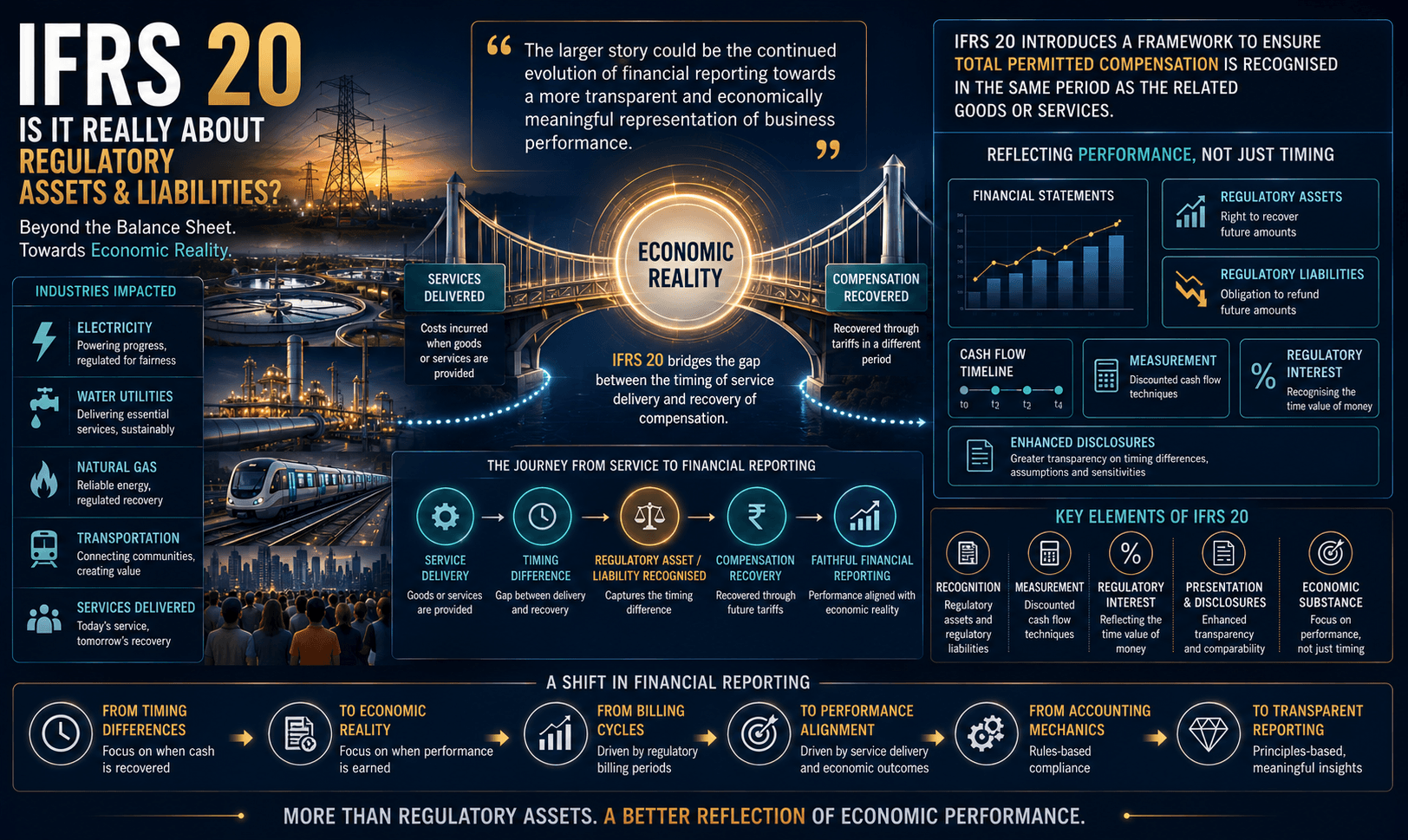
In many cases, there can be a disconnect between the period in which goods or services are delivered and the period in which the related compensation is recovered. As a result, revenue recognised in a particular reporting period may not fully reflect the compensation associated with the services provided during that same period.

This timing mismatch can make it difficult for financial statements to present a complete picture of an entity’s performance.

How IFRS 20 Addresses the Issue

IFRS 20 seeks to bridge this gap by introducing regulatory assets and regulatory liabilities that capture these timing differences.

The objective is to ensure that total permitted compensation is recognised in the same reporting period as the related goods or services. By doing so, the standard aims to improve the alignment between operational performance and financial reporting outcomes.

The technical implications of the standard are significant and include:

  • Recognition of regulatory assets and regulatory liabilities arising from timing differences
  • Measurement using discounted cash flow techniques
  • Recognition of regulatory interest
  • Enhanced presentation and disclosure requirements
  • Replacement of IFRS 14 and the introduction of a more comprehensive reporting framework

For affected entities, these changes will require careful evaluation of existing regulatory arrangements, measurement methodologies, and reporting processes.

Looking Beyond the Technical Requirements

What is particularly interesting about IFRS 20 is the philosophy underpinning the standard.

While the discussion often centres on the introduction of new balance sheet categories, the broader objective appears to be improving how financial performance is represented. The standard seeks to ensure that financial statements more faithfully reflect the economic consequences of providing regulated goods and services, even when billing and cash recovery occur across different reporting periods.

In that sense, regulatory assets and liabilities may be viewed as the mechanism through which a larger objective is achieved, namely, a more accurate representation of financial performance.

This aligns with a broader trend in financial reporting, where accounting standards increasingly focus on presenting economic reality rather than simply recording transactions based on their timing.

Preparing for the Transition

Although IFRS 20 becomes effective for annual reporting periods beginning on or after 1 January 2029, organisations should not underestimate the preparation required.

Identifying timing differences, evaluating enforceable rights and obligations, developing appropriate measurement models, and strengthening data collection processes will all require considerable planning and professional judgment.

For many entities, implementation will involve collaboration across finance, regulatory, operational, and technology functions to ensure a smooth transition.

More Than a New Accounting Standard

IFRS 20 is undoubtedly a technical standard. Yet its significance may extend beyond the creation of regulatory assets and liabilities.

At its core, the standard appears to reinforce a fundamental principle of modern financial reporting: financial statements should reflect economic performance as faithfully as possible, even when commercial, regulatory, and cash flow realities do not align neatly within a reporting period.

The new accounting requirements may attract the headlines, but the larger story could be the continued evolution of financial reporting towards a more transparent and economically meaningful representation of business performance.

Financial Reporting Is Entering a New Era of Continuous Change

Financial reporting is undergoing one of its most significant transformations in recent years.

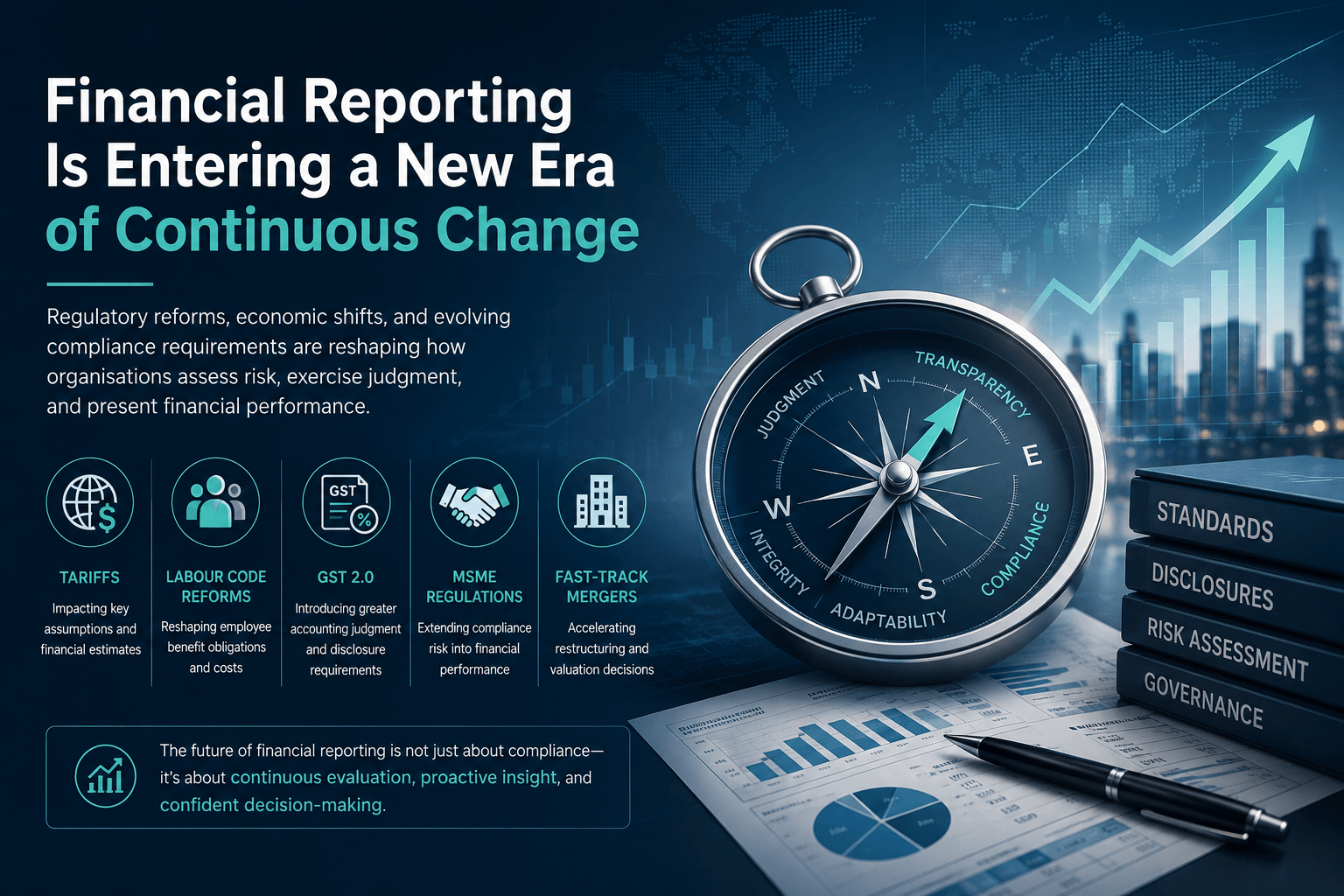
A combination of regulatory reforms, economic shifts, and evolving compliance requirements is forcing organisations to rethink how they assess risk, make judgments, and present financial performance. What were once considered external developments are now having a direct impact on financial reporting outcomes.

Financial reporting is no longer simply about applying accounting standards. It is increasingly about understanding how external developments affect business realities and ensuring those impacts are appropriately reflected in financial statements.

Several developments illustrate this shift.

Tariffs Are Becoming a Financial Reporting Variable

Changes in global tariff regimes are no longer confined to trade and supply chain discussions. They are beginning to influence key financial reporting areas, including impairment assessments, inventory valuation, revenue recognition, and expected credit loss calculations.

For businesses with significant cross-border exposure, assumptions around pricing, demand, profitability, and recoverability are becoming more volatile and increasingly dependent on management judgment. As trade dynamics evolve, organisations will need to revisit these assumptions more frequently and ensure that the rationale behind key estimates is adequately documented.

Labour Code Reforms Will Reshape Employee Cost Structures

The introduction of a uniform definition of wages and the expansion of gratuity-related provisions are expected to increase employee benefit obligations across many organisations.

The significance of these changes lies not only in their financial impact but also in their timing. These developments can trigger immediate recognition requirements under Ind AS 19, requiring companies to reassess employee benefit liabilities and reflect the impact within the same reporting period.

For finance leaders, this means evaluating workforce-related obligations proactively rather than treating them as a year-end exercise.

GST 2.0 Brings Greater Accounting Judgment

The next phase of GST reforms, including changes around Input Tax Credit (ITC) reversals and rate rationalisation, introduces accounting considerations that extend well beyond operational compliance.

Many of these changes create situations where more than one accounting treatment may be technically supportable. In such scenarios, consistency in application, robust documentation, and transparent disclosures become critical.

As tax regulations continue to evolve, organisations will need stronger coordination between finance, tax, and compliance teams to ensure reporting positions remain defensible and consistent.

MSME Regulations Are Extending Compliance Risk Into Financial Performance

Recent revisions to MSME thresholds and payment-related requirements mean that a larger supplier base now falls within the scope of MSME regulations.

As a result, payment delays are no longer merely operational concerns. They can have direct implications for tax deductibility and financial outcomes.

This development highlights the growing need for integration between procurement, finance, and compliance functions. Organisations that continue to manage these areas in silos may find themselves exposed to both regulatory and financial reporting risks.

Fast-Track Mergers Are Accelerating Restructuring Decisions

The introduction of simplified merger processes and reduced regulatory friction is making corporate restructuring more accessible and efficient.

This is likely to encourage greater consolidation activity across sectors. However, faster execution does not reduce the need for careful assessment of accounting, valuation, and disclosure implications.

Companies considering restructuring initiatives will need to ensure that financial reporting considerations are evaluated early in the decision-making process rather than addressed after transactions are underway.

A Broader Shift in Financial Reporting

Taken together, these developments point to a broader shift in the financial reporting landscape:

  • From static standards to dynamic interpretation
    • From siloed compliance to interconnected impact
    • From year-end adjustments to continuous monitoring
    • From periodic assessments to real-time decision support

The challenge for organisations will not be understanding individual regulatory changes. The real challenge lies in building the systems, governance frameworks, and cross-functional coordination needed to identify, assess, and respond to their implications as they emerge.

Financial reporting is increasingly becoming a forward-looking discipline. Organisations that invest in stronger processes, better data visibility, and proactive risk assessment will be better positioned to navigate this new environment.

The era of annual compliance-driven reporting is gradually giving way to one of continuous evaluation and dynamic interpretation. Finance leaders who recognise this shift early will be better equipped to manage uncertainty while maintaining transparency, credibility, and stakeholder confidence.

Opinion – The Production Process Is Only as Strong as the Four “Rights” Behind It

Manufacturing leaders across industries continuously ask themselves an important question: “Is our production process right?”

Most organisations answer this question by evaluating production efficiency, machine utilisation, output quality, or turnaround time. While these are important indicators, they often focus only on what happens inside the production facility.

The bigger reality is this: a production process does not begin on the factory floor. It begins much earlier.

Before a single product is manufactured, before machines start operating, and before assembly lines move into action, four critical foundations determine whether the production process will ultimately succeed or fail.

These are:

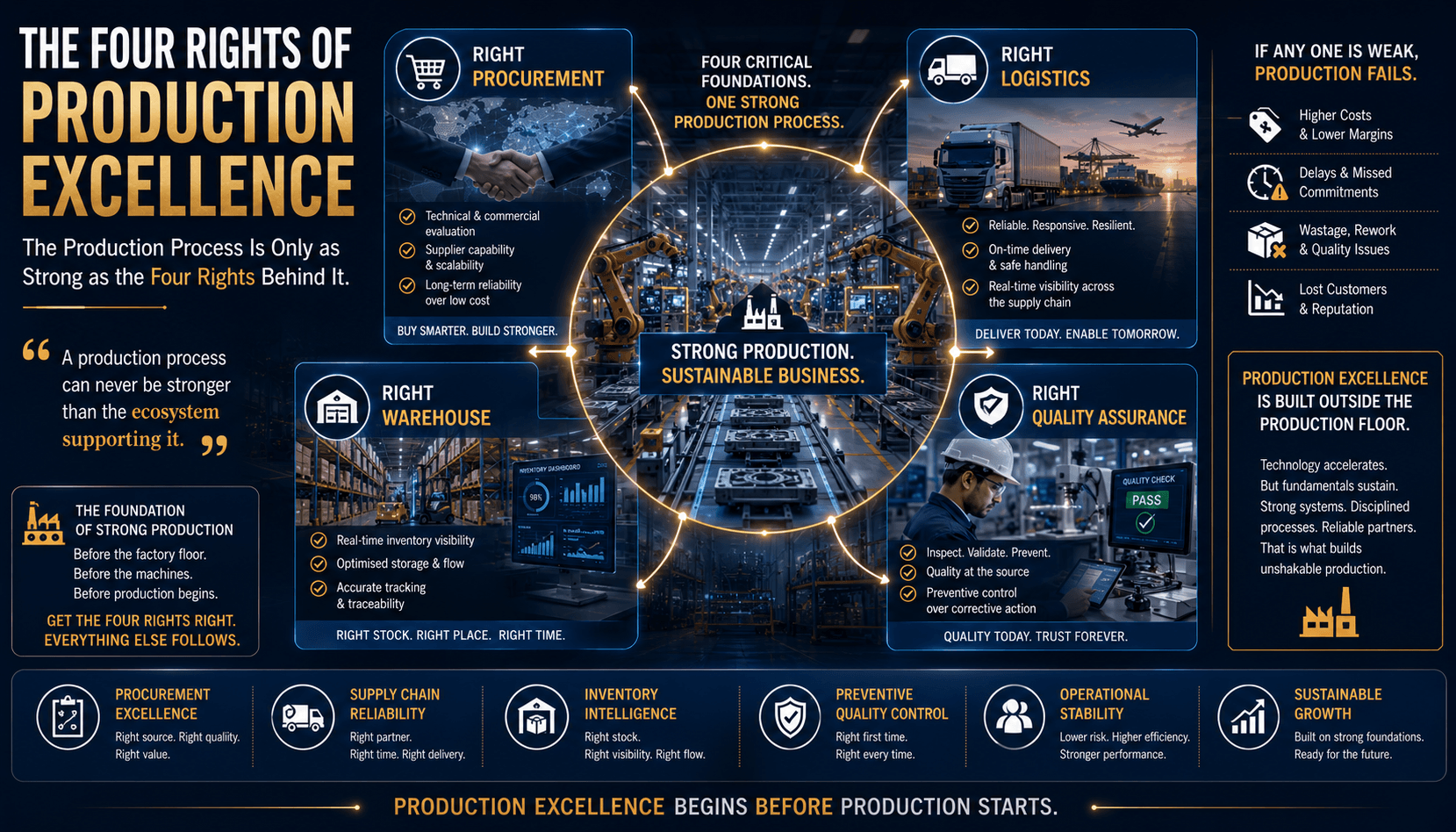
  1. The right source of procurement
  2. The right logistics partner
  3. The right warehouse management
  4. The right quality assurance

If any one of these four pillars is weak, the production process itself becomes unstable, regardless of how advanced the manufacturing setup may appear.

Procurement Is Not Just About Price

Many businesses still approach procurement primarily through a cost lens. The assumption is simple: lower procurement costs improve margins.

But procurement decisions made only on commercial considerations can create serious operational risks later.

The right source of procurement requires both technical and commercial evaluation. Companies must assess whether suppliers possess the capability, consistency, scalability, and long-term viability required to support production demands.

A vendor may offer attractive pricing today, but if they fail to maintain quality consistency, delivery timelines, or operational reliability, the downstream impact on production can be severe.

Strategic procurement is therefore not about buying cheaper. It is about buying smarter.

Logistics Determines Operational Continuity

Even when procurement decisions are correct, production efficiency can collapse if logistics systems are weak.

A delayed shipment, damaged goods in transit, or poor coordination between suppliers and factories can disrupt production schedules instantly. In industries where timelines directly impact customer commitments, even minor logistics failures can result in financial and reputational losses.

The right logistics partner is not merely a transportation vendor. They are an operational extension of the business.

Companies today need logistics ecosystems that prioritise reliability, visibility, responsiveness, and safe handling of goods. As supply chains become increasingly global and interconnected, logistics efficiency is becoming a competitive differentiator rather than a backend support function.

Warehouse Management Is No Longer a Passive Function

Warehousing has traditionally been viewed as a storage activity. That perception is rapidly changing.

Modern warehouse management plays a central role in operational control and inventory intelligence.

If inventory is not properly tracked, monitored, stored, or rotated, organisations face risks such as wastage, stock mismatches, material deterioration, and production delays. Poor warehouse visibility also affects forecasting accuracy and working capital efficiency.

The right warehouse management system ensures that businesses maintain real-time control over materials and inventory movement. In an environment where supply chain agility matters more than ever, warehousing must evolve from being a static infrastructure function into a strategic operational capability.

Quality Assurance Must Begin Before Production

One of the biggest operational mistakes organisations make is treating quality assurance as a post-production exercise.

In reality, quality assurance must begin before raw materials even enter the warehouse or production line.

The right quality assurance processes ensure that incoming materials meet technical and operational standards before they move further into the system. If defective or inconsistent inputs enter production, the cost of correction multiplies significantly downstream.

Quality failures discovered during or after production create rework, delays, wastage, customer dissatisfaction, and reputational damage. Preventive quality control is therefore far more valuable than reactive correction.

Strong quality assurance systems protect not just products, but also operational stability.

Production Excellence Is Built Outside the Production Floor

In today’s business environment, operational excellence is often discussed in the context of automation, AI, digital manufacturing, and smart factories.

While technology is undoubtedly important, sustainable production success still depends on getting the fundamentals right.

The strongest manufacturing systems are not built only through faster machines or advanced software. They are built through disciplined procurement practices, reliable logistics networks, intelligent warehouse management, and rigorous quality assurance frameworks.

A production process can never be stronger than the ecosystem supporting it.

And that is perhaps the most important lesson for businesses today:

Before asking whether your production process is right, ask whether the four “rights” behind it are truly in place.


The Latest Ind AS Amendments Are Changing More Than Accounting Standards

The latest Ind AS amendments may appear technical on the surface, but their implications extend far beyond accounting compliance.

These changes are set to influence how organisations manage debt, monitor financial risks, assess tax exposures, and communicate with investors and lenders. For finance leaders, the focus is shifting from technical interpretation to operational readiness.

While accounting standards are often viewed through a compliance lens, the latest amendments have implications that extend well beyond financial reporting. They influence liquidity management, financing decisions, tax planning, stakeholder communication, and governance practices.

Several developments stand out.

Liability Classification Is No Longer Open to Interpretation

One of the most significant changes relates to the classification of liabilities.

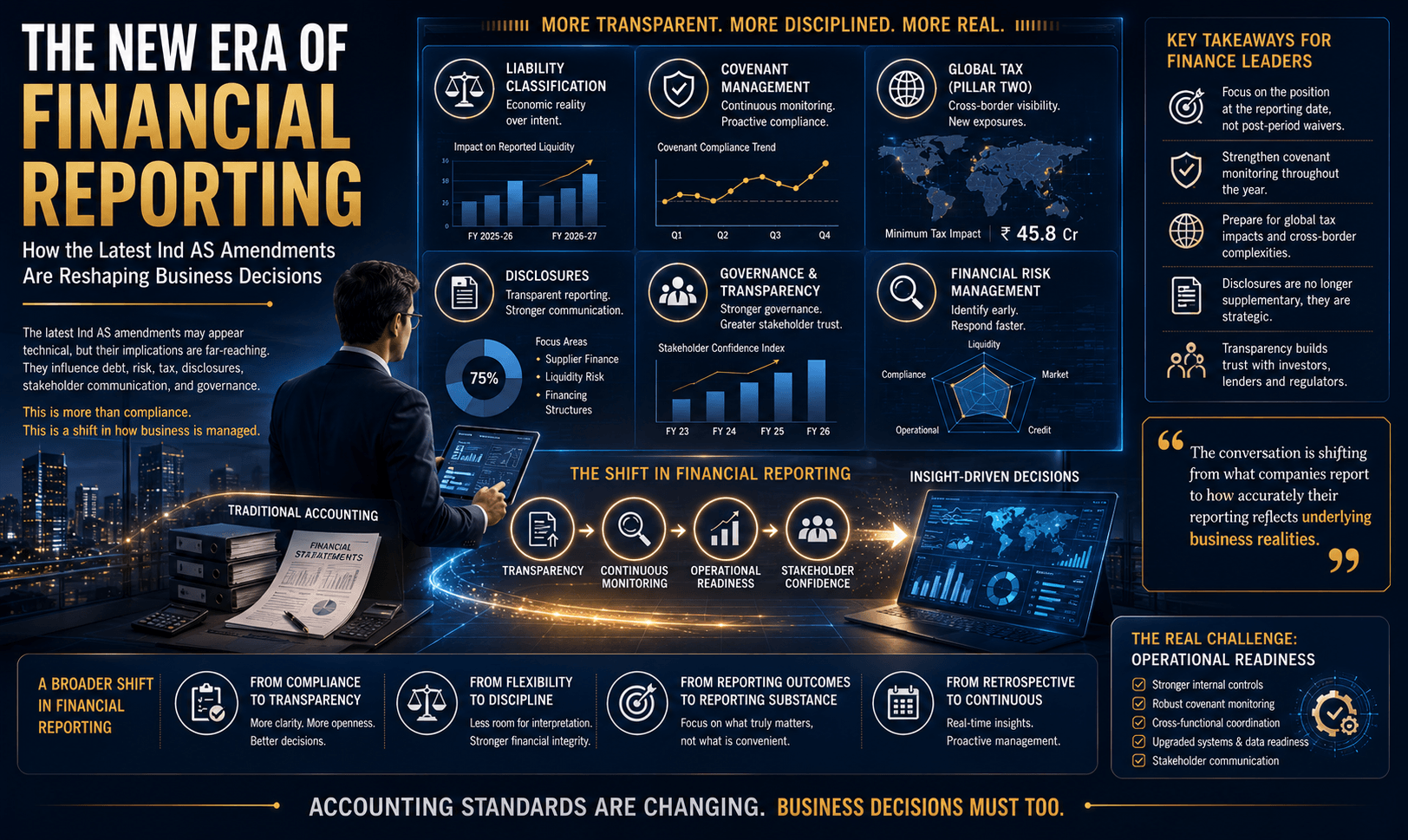
Beginning FY 2026-27, post-reporting date waivers from lenders will no longer influence whether a liability is classified as current or non-current. If an entity does not have the right to defer settlement of an obligation at the reporting date, the liability must be classified as current.

This places complete emphasis on the position that exists as of the balance sheet date rather than management’s expectations or subsequent developments.

For companies with structured debt arrangements, refinancing plans, or covenant-linked borrowings, the impact could be substantial. Reported liquidity positions may look materially different, even when long-term financing discussions are underway.

Covenant Management Must Become Proactive

The amendments also reinforce the importance of covenant monitoring.

Historically, some organisations could address covenant-related concerns through post year-end lender discussions and waivers. That flexibility is becoming increasingly limited. Classification outcomes will now depend on whether covenant requirements have been satisfied at the reporting date.

As a result, covenant compliance can no longer be viewed as a year-end exercise.

Finance leaders will need stronger monitoring mechanisms throughout the year, supported by regular dialogue with lenders and early identification of potential breaches. The objective is no longer simply resolving issues, but preventing them from affecting financial reporting outcomes in the first place.

Global Tax Is Becoming a Financial Reporting Consideration

The introduction of Pillar Two marks another important shift.

Tax is no longer solely a local compliance matter. Indian companies with international operations, as well as subsidiaries of multinational groups, may face tax implications that span multiple jurisdictions.

This creates new challenges around data availability, system readiness, and visibility across global operations. Organisations will need greater coordination between finance, tax, and technology functions to understand potential exposures and ensure accurate reporting.

For many businesses, this may require capabilities that extend well beyond traditional tax compliance frameworks.

Disclosures Are Becoming Strategic Decision Tools

Another notable development is the growing significance of disclosures.

Areas such as supplier finance arrangements, liquidity risk, and financing structures now require more transparent and meaningful reporting. Stakeholders increasingly rely on disclosures to understand the quality of earnings, resilience of cash flows, and the overall financial health of an organisation.

In this environment, the notes to accounts are no longer supplementary information. They are becoming an integral part of the financial story.

Investors, lenders, analysts, and regulators are paying closer attention to what organisations disclose, how they disclose it, and what those disclosures reveal about risk and governance practices.

A Broader Shift in Financial Reporting

Taken together, these amendments signal a larger transformation in financial reporting:

  • From compliance to transparency
    • From flexibility to discipline
    • From reporting outcomes to reporting substance
    • From retrospective assessment to continuous monitoring

The direction of travel is clear. Financial reporting is becoming more reflective of economic reality and less influenced by post-period adjustments or management intent.

The Real Challenge Is Operational Readiness

For most organisations, understanding the amendments will not be the difficult part.

The greater challenge will be ensuring operational readiness. This includes strengthening internal controls, improving covenant monitoring processes, enhancing cross-functional coordination, upgrading reporting systems, and preparing stakeholders for the impact of these changes.

The latest Ind AS amendments are ultimately about increasing transparency and strengthening confidence in financial reporting. Organisations that adapt early will be better positioned to navigate these requirements while providing stakeholders with a clearer and more reliable picture of their financial position.

In many ways, the conversation is shifting from what companies report to how accurately their reporting reflects underlying business realities. That is a significant change, and one that finance leaders cannot afford to overlook.

Opinion – The Trusted Manufacturer: Why Credibility Is the New Competitive Moat

For much of the last two decades, Indian manufacturing operated on a formula that was simple and, for a long time, effective: compete on cost, scale on volume, protect margins. It worked. But something is shifting, and the manufacturers who recognise it early will define the next era of Indian industry.

The shift is this: buyers are no longer just buying a product. They are buying into a relationship, and increasingly, into a governance framework. Price gets you into consideration. Trust gets you the contract, and more importantly, keeps you in it.

What Trust Actually Means in a Business Context

Trust in manufacturing is not an abstract value. It is a set of operational behaviours that compound over time. It is the quality that holds on the tenth order, not just the first. It is after-sales service that does not evaporate once payment clears. It is delivery timelines kept consistently enough that a buyer stops building buffer inventory to account for you. It is documentation and compliance that does not fall apart the moment someone looks closely.

The Trusted Manufacturer is built not by a single impressive performance but by the absence of failures over time. And critically, it is built through systems, not personalities. A business that runs well because of one exceptional individual is fragile. A business that runs well because its processes are disciplined and its controls are embedded is durable. This is a distinction that matters enormously when a buyer is deciding whether to deepen a relationship or quietly begin qualifying alternatives.

The Real Cost of Getting This Wrong

The financial case for trust-based operations is often underappreciated because many of its costs are invisible until something goes wrong. Quality professionals estimate that poor quality in manufacturing typically costs between 15 and 20 percent of annual sales revenue once rework, scrap, warranty claims, customer complaints and lost business are fully accounted for. For many manufacturers, that number is buried across departments and never surfaces as a single line item. But buyers see it, even when suppliers do not.

A buyer who absorbs a compliance failure, a missed shipment, or a quality defect does not simply absorb the direct cost. They absorb the downstream consequence: a production line delayed, a customer of their own disappointed, a relationship strained. The opportunity cost of dealing with an unreliable supplier is substantial. Sophisticated buyers are increasingly quantifying it before making sourcing decisions, not after. In practice, this means the manufacturer with the cleaner track record often wins the contract even when their unit price is not the lowest in the room.

Where Regulation Is Accelerating the Shift

The urgency around trust-based trade is also being driven by external forces. Global regulatory environments, particularly in Europe, are raising the bar on supply chain scrutiny. Buyers in regulated markets are now legally required to know more about their suppliers than they were five years ago. ESG disclosures, emissions reporting, labour practice audits: these requirements are pushing compliance from a back-office checkbox into a frontline procurement criterion.

For Indian manufacturers with ambitions in export markets, this creates both a risk and an opportunity. The risk is being filtered out of supplier shortlists not on price or quality, but on governance readiness. The opportunity is that manufacturers who build robust internal controls, clean audit trails, and verifiable compliance frameworks now will hold a genuine advantage over those who treat compliance as a fire drill. Many businesses are already making this investment, often with outside advisory support, and the results are showing up in procurement conversations in ways that pure cost reduction cannot replicate.

From Cost Competition to Credibility Competition

The manufacturers gaining ground today share a common characteristic. They are not necessarily the lowest-cost players. They are the most consistent. Their operations run on documented processes. Their audit trails are clean. Their customers refer them because the experience of working with them removes friction rather than adding it.

This is the emergence of a new competitive category: the Trusted Manufacturer. It is a position earned over time through accumulated customer experience, and it commands a premium that no short-term cost reduction can easily undercut.

The transition from cost-based competition to credibility-based competition will not happen overnight. But the direction is clear. For Indian manufacturers, the question is not whether this shift is coming. It is whether they are building for it now, or planning to catch up later.