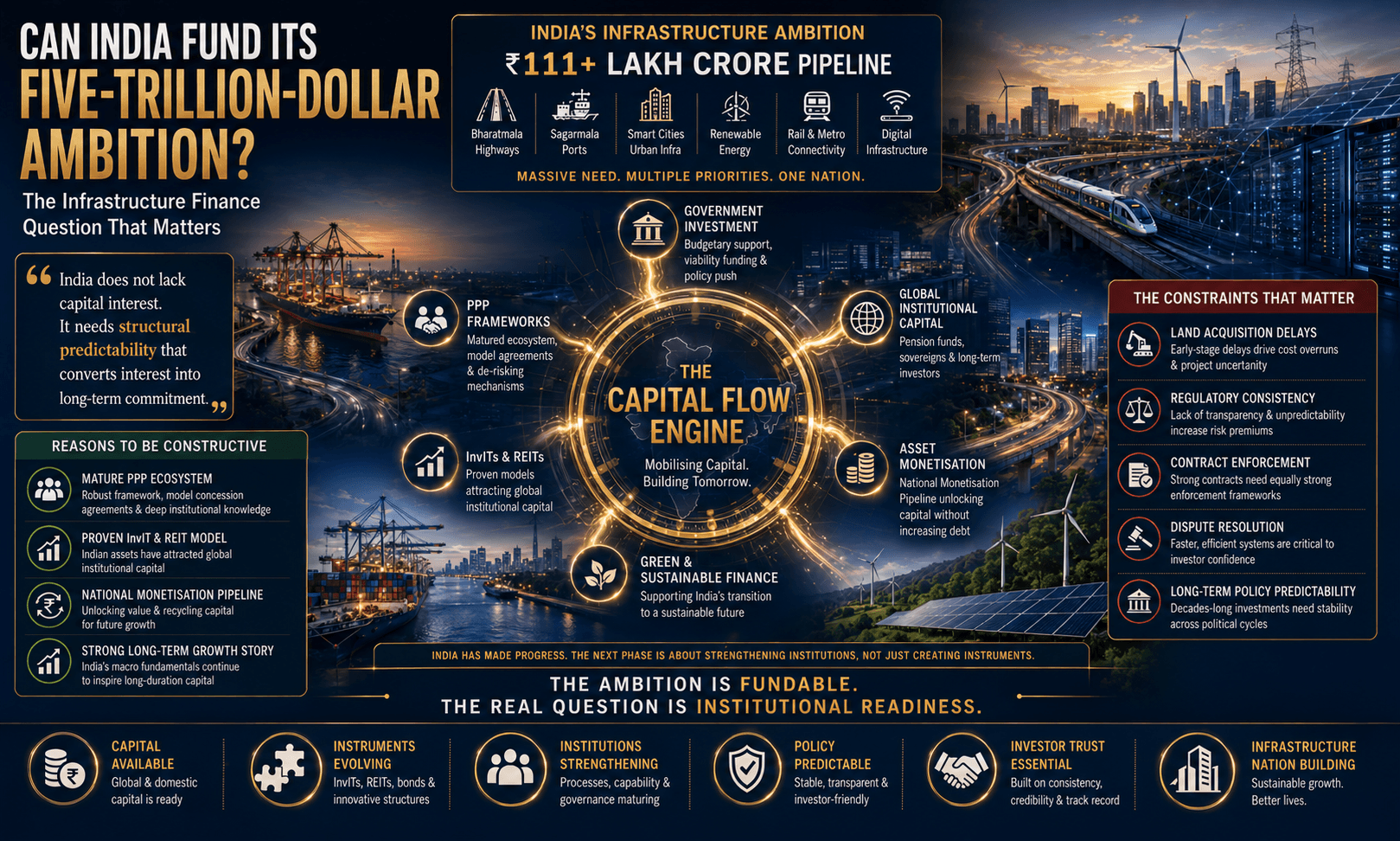
India’s infrastructure ambition is, by any measure, enormous. The National Infrastructure Pipeline alone targets over ₹111 lakh crore in investment. Add to this the Smart Cities Mission, Bharatmala, Sagarmala, and the renewable energy transition, and the capital requirement quickly exceeds what any single source, government, banking system, or capital market, can support on its own.
The question, therefore, is not theoretical. Can this scale of ambition actually be funded?
Reasons to be constructive
There are clear reasons for optimism. The PPP framework has matured significantly. Model concession agreements are in place. Institutional knowledge has deepened over two decades of transactions. This matters more than it appears, because a large part of what deters capital is not just uncertainty of returns, but uncertainty of process.
InvITs and REITs have demonstrated that Indian infrastructure and real estate assets can attract global institutional capital. The proof of concept is now established.
Asset monetisation through the National Monetisation Pipeline is unlocking capital without increasing sovereign borrowing. And India’s long-term growth trajectory continues to appeal to investors willing to take a long-duration view.
The constraints that matter
The challenges, however, are structural. Land acquisition remains one of the most persistent sources of delay and cost escalation. While regulatory safeguards have strengthened, the early stages of project development continue to be slow and unpredictable. Developers have adapted, and investors have priced this in. That does not mean the issue is resolved.
Regulatory consistency is another critical factor. Infrastructure investments are inherently long-term. Capital committed today is based on expectations that extend across decades.
When tariff frameworks lack transparency, or when regulatory decisions appear inconsistent, the impact is immediate. It reflects in higher risk premiums and, in some cases, in capital choosing alternative markets. Contract enforcement and dispute resolution complete the picture. The contracts themselves have become more sophisticated. The systems required to interpret and enforce them must evolve at the same pace.
What the five-trillion ambition requires
India has made meaningful progress in rebuilding its infrastructure financing architecture. The next phase is less about introducing new instruments and more about strengthening the institutional foundations that support them.
India does not lack capital interest. It needs structural predictability that converts interest into long-term commitment.
The ambition is fundable. The more important question is whether the institutional infrastructure can keep pace with the physical infrastructure.