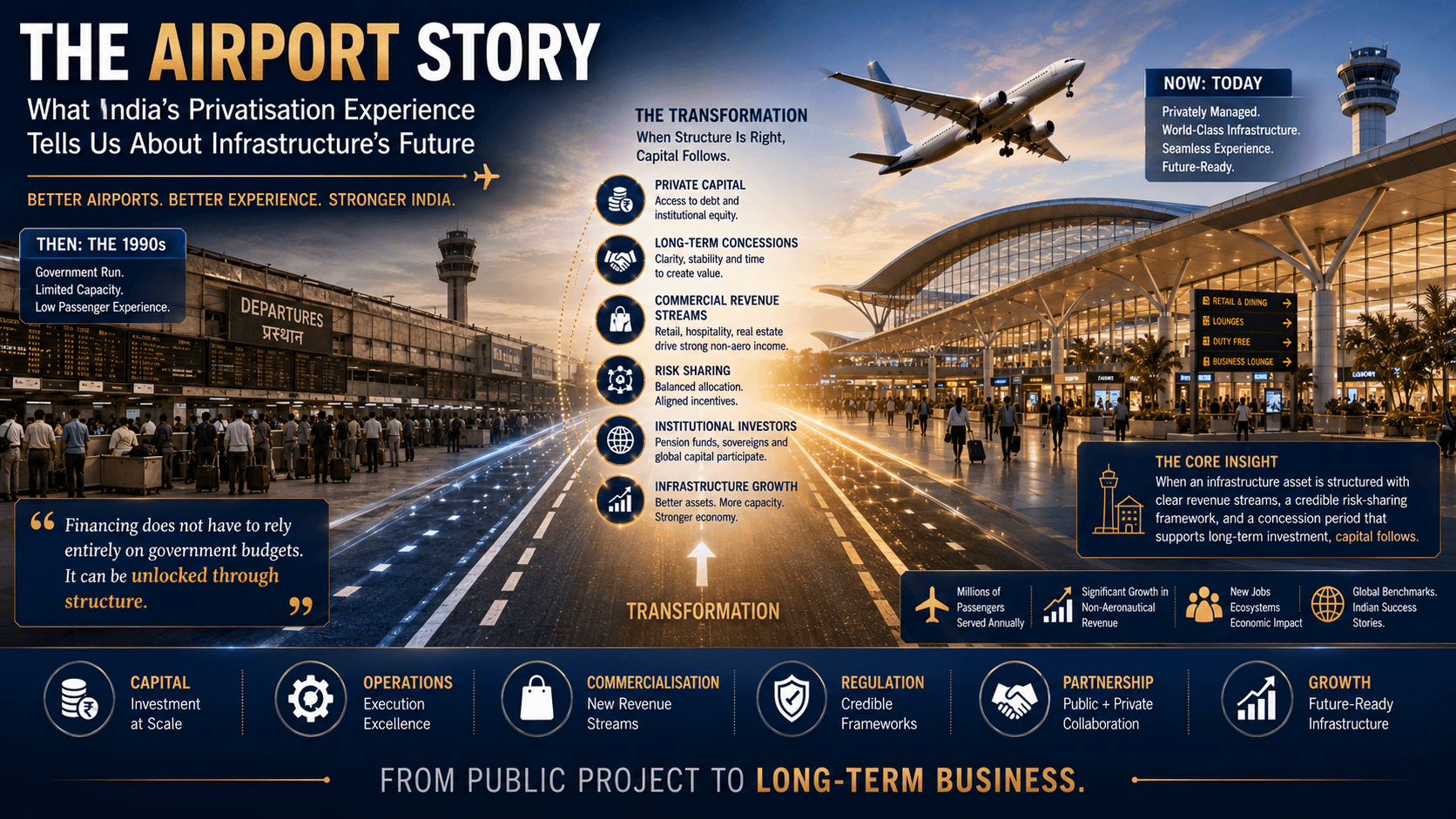
Think about the last time you flew through Delhi’s Terminal 3, or walked through one of Mumbai’s expanded terminals. Then try to recall what Indian airports looked like in the 1990s.
That gap is not just about architecture or passenger experience. It reflects what infrastructure can become when the underlying financial and operational structure is right.
India’s airport privatisation journey is one of the most instructive case studies for infrastructure development. It has delivered real outcomes. It has also surfaced real challenges.
What changed
Major airports in Delhi, Mumbai, Bengaluru and Hyderabad transitioned to private concessionaires under long-term agreements.
That shift brought more than capital. It introduced operational discipline, sharper execution, and a long-term approach to asset management.
Revenue streams that were once negligible became central to the model. Retail, hospitality, real estate and commercial development now contribute meaningfully to airport economics. This reduces dependence on aeronautical charges alone.
Access to capital also evolved. Airport operators today can raise debt and attract institutional equity in ways that were not possible under a purely government-run model.
The replicable lesson
The core insight from the airport experience is straightforward.
When an infrastructure asset is structured with clear revenue streams, a credible risk-sharing framework, and a concession period that supports long-term investment, capital follows.
Financing does not have to rely entirely on government budgets. It can be unlocked through structure.
This logic is now being extended to other sectors, ports, highways, urban transit and water infrastructure. Some of these applications are working well. Others are still navigating the institutional complexities that marked the early years of airport privatisation.
The unfinished business
Not every airport privatisation has been smooth.
Revenue-sharing disputes, questions around tariff setting, and gaps between projected and actual traffic have created friction. Some of these challenges have led to prolonged negotiations and, in certain cases, litigation.
The model works. But it works best when three elements are in place, regulatory credibility, effective dispute resolution, and contracts that are designed with foresight.
India is still strengthening these capabilities. The airport sector has served both as proof of concept and as a testing ground.
What this means going forward
The story is still unfolding.
But one thing is clear. Infrastructure delivers better outcomes when it is structured as a long-term business with public purpose, rather than treated purely as a public project.
That is the lesson the airport sector offers. And it is a lesson worth applying more widely.