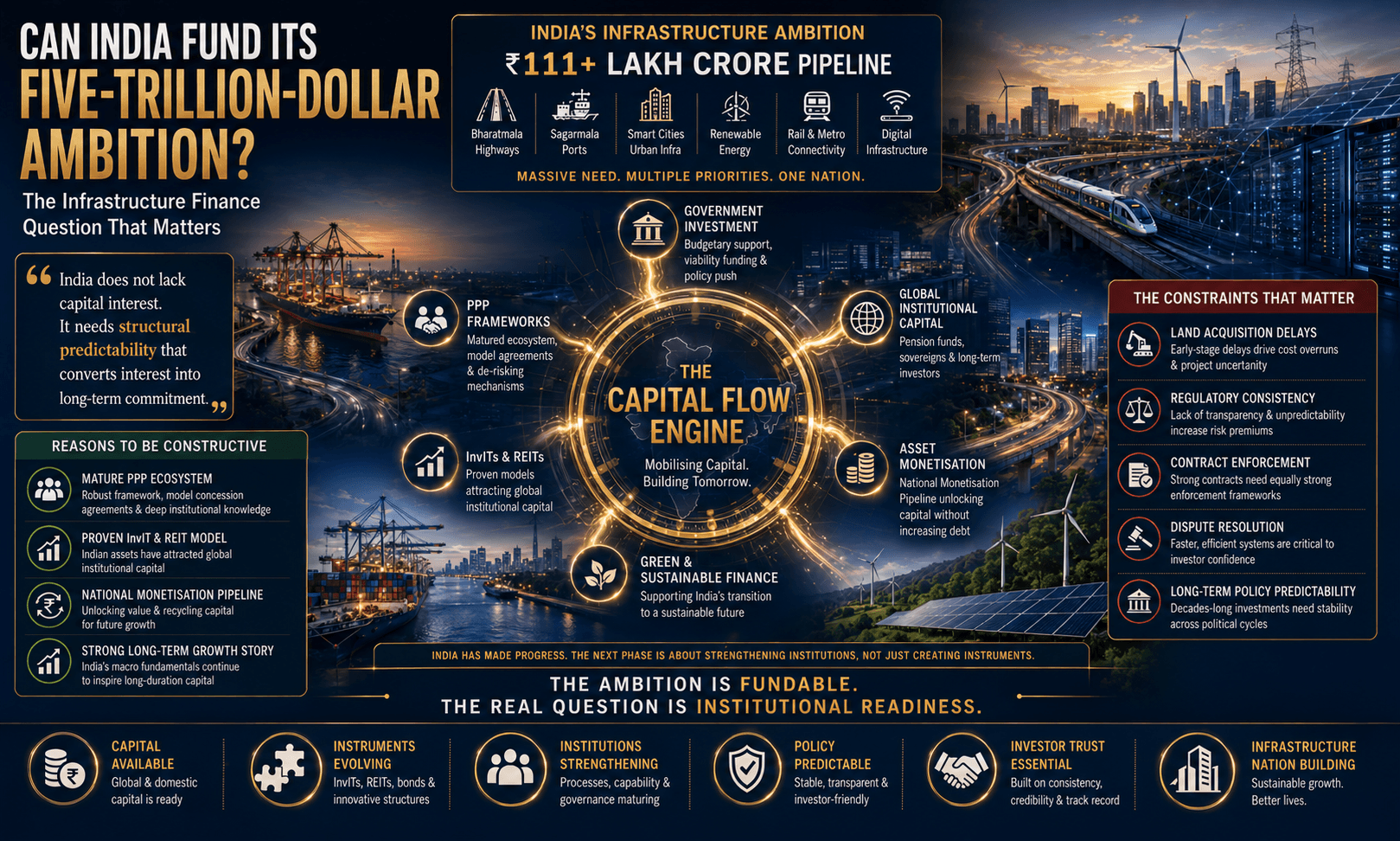

Can India Fund Its Five-Trillion-Dollar Ambition? The Infrastructure Finance Question That Matters

India’s infrastructure ambition is, by any measure, enormous. The National Infrastructure Pipeline alone targets over ₹111 lakh crore in investment. Add to this the Smart Cities Mission, Bharatmala, Sagarmala, and the renewable energy transition, and the capital requirement quickly exceeds what any single source, government, banking system, or capital market, can support on its own.

The question, therefore, is not theoretical. Can this scale of ambition actually be funded?

Reasons to be constructive

There are clear reasons for optimism. The PPP framework has matured significantly. Model concession agreements are in place. Institutional knowledge has deepened over two decades of transactions. This matters more than it appears, because a large part of what deters capital is not just uncertainty of returns, but uncertainty of process.

InvITs and REITs have demonstrated that Indian infrastructure and real estate assets can attract global institutional capital. The proof of concept is now established.

Asset monetisation through the National Monetisation Pipeline is unlocking capital without increasing sovereign borrowing. And India’s long-term growth trajectory continues to appeal to investors willing to take a long-duration view.

The constraints that matter

The challenges, however, are structural. Land acquisition remains one of the most persistent sources of delay and cost escalation. While regulatory safeguards have strengthened, the early stages of project development continue to be slow and unpredictable. Developers have adapted, and investors have priced this in. That does not mean the issue is resolved.

Regulatory consistency is another critical factor. Infrastructure investments are inherently long-term. Capital committed today is based on expectations that extend across decades.

When tariff frameworks lack transparency, or when regulatory decisions appear inconsistent, the impact is immediate. It reflects in higher risk premiums and, in some cases, in capital choosing alternative markets. Contract enforcement and dispute resolution complete the picture. The contracts themselves have become more sophisticated. The systems required to interpret and enforce them must evolve at the same pace.

What the five-trillion ambition requires

India has made meaningful progress in rebuilding its infrastructure financing architecture. The next phase is less about introducing new instruments and more about strengthening the institutional foundations that support them.

India does not lack capital interest. It needs structural predictability that converts interest into long-term commitment.

The ambition is fundable. The more important question is whether the institutional infrastructure can keep pace with the physical infrastructure. 

The Airport Story: What India’s Privatisation Experience Tells Us About Infrastructure’s Future

Think about the last time you flew through Delhi’s Terminal 3, or walked through one of Mumbai’s expanded terminals. Then try to recall what Indian airports looked like in the 1990s.

That gap is not just about architecture or passenger experience. It reflects what infrastructure can become when the underlying financial and operational structure is right.

India’s airport privatisation journey is one of the most instructive case studies for infrastructure development. It has delivered real outcomes. It has also surfaced real challenges.

What changed

Major airports in Delhi, Mumbai, Bengaluru and Hyderabad transitioned to private concessionaires under long-term agreements.

That shift brought more than capital. It introduced operational discipline, sharper execution, and a long-term approach to asset management.

Revenue streams that were once negligible became central to the model. Retail, hospitality, real estate and commercial development now contribute meaningfully to airport economics. This reduces dependence on aeronautical charges alone.

Access to capital also evolved. Airport operators today can raise debt and attract institutional equity in ways that were not possible under a purely government-run model.

The replicable lesson

 The core insight from the airport experience is straightforward.

When an infrastructure asset is structured with clear revenue streams, a credible risk-sharing framework, and a concession period that supports long-term investment, capital follows.

Financing does not have to rely entirely on government budgets. It can be unlocked through structure.

This logic is now being extended to other sectors, ports, highways, urban transit and water infrastructure. Some of these applications are working well. Others are still navigating the institutional complexities that marked the early years of airport privatisation.

The unfinished business

Not every airport privatisation has been smooth.

Revenue-sharing disputes, questions around tariff setting, and gaps between projected and actual traffic have created friction. Some of these challenges have led to prolonged negotiations and, in certain cases, litigation.

The model works. But it works best when three elements are in place, regulatory credibility, effective dispute resolution, and contracts that are designed with foresight.

India is still strengthening these capabilities. The airport sector has served both as proof of concept and as a testing ground.

What this means going forward

The story is still unfolding.

But one thing is clear. Infrastructure delivers better outcomes when it is structured as a long-term business with public purpose, rather than treated purely as a public project.

That is the lesson the airport sector offers. And it is a lesson worth applying more widely.

Why InvITs and REITs Are the Financial Innovation India Did Not Talk About Enough

Ask most people what a Real Estate Investment Trust (REIT) is, and you will get a blank stare. Ask an infrastructure developer what an Infrastructure Investment Trust (InvIT) has done for their balance sheet, and you will hear something quite different.

Real Estate Investment Trusts and Infrastructure Investment Trusts have emerged as among the most consequential financial innovations in India’s infrastructure story. Quietly, and without the visibility of policy announcements, they have reshaped how developers think about capital and how investors approach India.

The problem they solved

 Developers of infrastructure and real estate have always faced a particular kind of constraint.

Their best assets, operational highways, stabilised office parks, running power lines, sit on the balance sheet generating cash, but locking in capital that could otherwise fund the next phase of growth. The assets perform. The limitation is that they cannot easily be converted into liquidity without selling them outright, and selling them outright often means losing operational control.

InvITs and REITs addressed this directly.

By allowing developers to list operational assets on public markets, these instruments created a monetisation path that did not require exiting the business. Developers could recycle capital, reinvest in new projects, and retain a continuing economic interest in the underlying assets.

That combination had not been available earlier.

What has changed on the ground

The impact is now visible across sectors.

  • Highway InvITs hold thousands of kilometres of operational toll roads, opening access to infrastructure yields that were once limited to large institutions.
  • Office REITs in Bengaluru, Mumbai and Hyderabad have become benchmarks for institutional-grade real estate, attracting global pension funds and sovereign investors.
  • The model has enabled asset recycling at scale, allowing developers to monetise, reinvest and build again without waiting for traditional funding cycles.

A decade ago, these were not assets you could meaningfully access as an investor. Today, they are part of mainstream portfolios.

The investor case

For long-term investors, including pension funds, insurance companies and family offices, these instruments offer something that is harder to find than it appears, predictable, yield-generating assets with regulatory oversight and tradeable liquidity.

In a world searching for stable yield, these instruments are no longer niche. They are increasingly becoming part of core portfolio allocations.

A note of caution

These structures are not simple.

Governance arrangements, related-party transactions, interest rate exposure and sector-specific demand risks all require careful scrutiny. SEBI’s regulatory framework has matured considerably, and that has added credibility to the market. But investors who treat InvITs or REITs as straightforward fixed-income substitutes are not reading the instrument correctly.

What comes next

The real question now is not whether these structures work. The data on that is reasonably clear.

The question is how far they can scale, and what might limit that scale.

India’s Infrastructure Finance: From Babus to Boardrooms

When I started advising on infrastructure projects nearly two decades ago, the financing conversation followed a fairly predictable script. You went to a public sector bank, negotiated a long-term loan, and then spent the next several months hoping land acquisition would not derail your timeline before the monsoons arrived.

Risk sat with the government. Money came from the same few places. Results were uneven, and everyone knew why.

That world is gone. What has replaced it is something genuinely different, and in many ways more interesting to work in.

The old model and why it broke

For most of independent India’s history, infrastructure was a government affair. Roads came from budgetary allocations. Railways ran on sovereign borrowings. Power projects were financed through public sector banks that absorbed risk that was, frankly, not theirs to absorb.

Looking back, three fault lines defined that system.

First, banks were lending long against short-term deposits, a mismatch that was always going to create stress. Second, financial, operational and political risk was concentrated with one entity, the government. That concentration led to inefficiency and, eventually, inertia. Third, no government budget was ever going to keep pace with the scale of infrastructure India actually needed.

By the early 2010s, the system had buckled. Non-performing assets mounted. Projects stalled. It became clear that the architecture itself needed rethinking.

What has changed

The shift took time, and it is still unfolding, but the direction is unmistakable.

Public-Private Partnerships have moved from policy aspiration to operational reality. Build-Operate-Transfer, the Hybrid Annuity Model and Design-Build-Finance-Operate structures now define how roads, metro rails and airports get built. Risk is shared rather than concentrated, and that changes incentives across the lifecycle of a project.

In many of the projects I have been involved with, you can see this shift clearly.

Capital markets have entered the picture in a serious way. Infrastructure Investment Trusts and Real Estate Investment Trusts have created a new class of participants, retail investors, global pension funds and sovereign wealth funds, who now have a genuine stake in Indian highways and Grade-A office parks.

A decade ago, these were not assets you could invest in. Today, they are part of mainstream portfolios.

Governments have also started monetising what they already own. Rather than relying only on fresh borrowing, the approach now is to lease operational toll roads, airports and pipelines, use the proceeds to fund new projects, and recycle capital more efficiently.

And ESG considerations, once seen as peripheral, have quietly become central to investor decision-making. Green bonds and sustainability-linked frameworks are now part of how serious infrastructure capital is deployed.

What this means on the ground

Nowhere is the transformation more visible than in real estate and technology parks. The rise of REITs has opened access to Grade-A office assets that were once held almost entirely by institutions.

Cities like Bengaluru, Hyderabad and Mumbai are now investable markets for global capital in ways they simply were not before. Smart cities, data centres and fintech hubs have moved from aspiration to active deal flow.

Where we go from here

India’s ambition to reach a five-trillion-dollar economy rests, in significant part, on getting infrastructure finance right.

India does not have a capital shortage. It has a capital structure challenge.

Progress has been real. But the next phase will require deeper capital market development, stronger institutional capacity for contract management and dispute resolution, and policy consistency that gives investors the confidence to commit capital over long time horizons.

The babus are still in the room. So are the boardrooms.

The most interesting work now happens at their intersection.

What has your experience been with the changing infrastructure finance landscape? I would be glad to hear from developers, investors and policymakers in the comments.