

For much of the last two decades, Indian manufacturing operated on a formula that was simple and, for a long time, effective: compete on cost, scale on volume, protect margins. It worked. But something is shifting, and the manufacturers who recognise it early will define the next era of Indian industry.
The shift is this: buyers are no longer just buying a product. They are buying into a relationship, and increasingly, into a governance framework. Price gets you into consideration. Trust gets you the contract, and more importantly, keeps you in it.
What Trust Actually Means in a Business Context
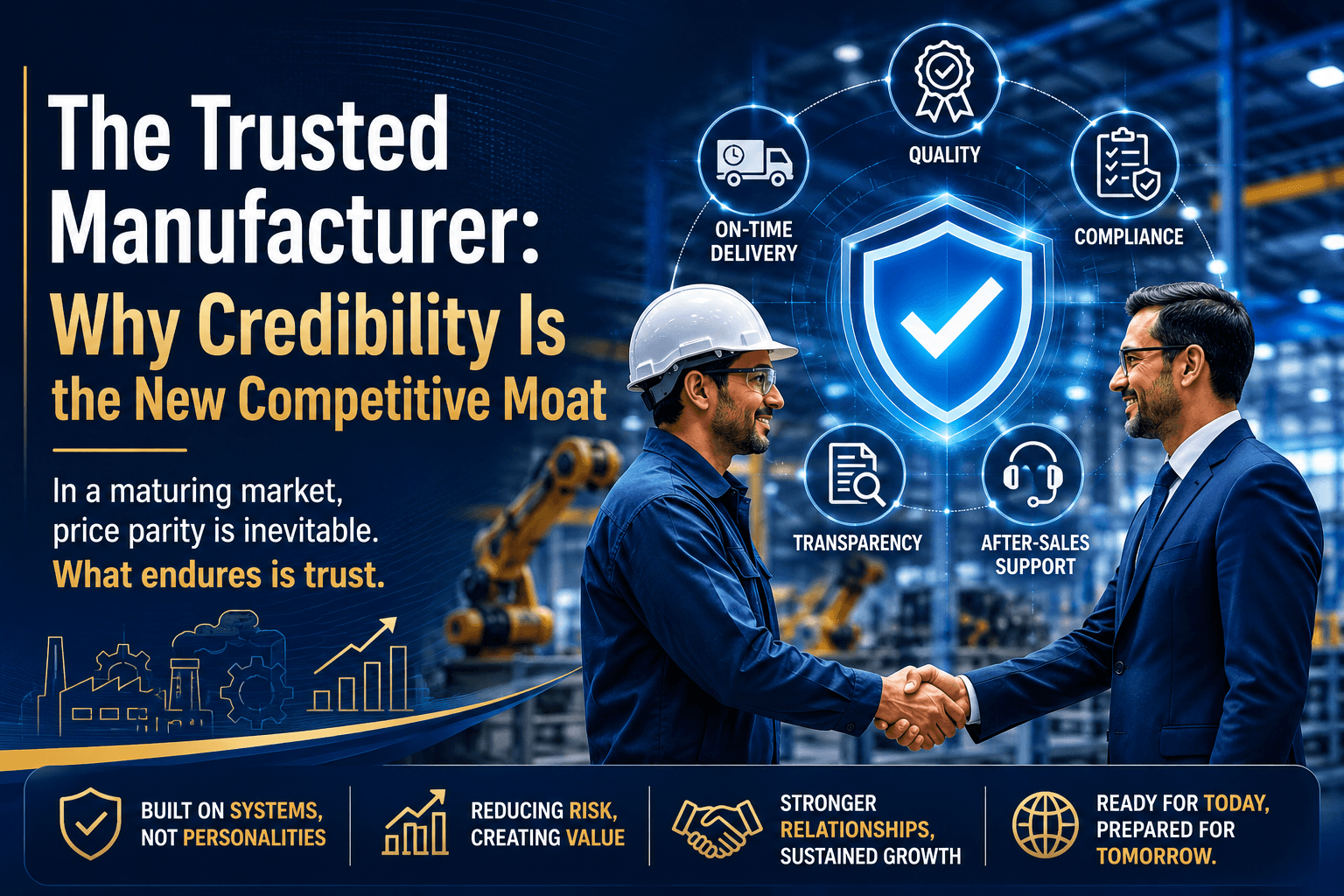
Trust in manufacturing is not an abstract value. It is a set of operational behaviours that compound over time. It is the quality that holds on the tenth order, not just the first. It is after-sales service that does not evaporate once payment clears. It is delivery timelines kept consistently enough that a buyer stops building buffer inventory to account for you. It is documentation and compliance that does not fall apart the moment someone looks closely.
The Trusted Manufacturer is built not by a single impressive performance but by the absence of failures over time. And critically, it is built through systems, not personalities. A business that runs well because of one exceptional individual is fragile. A business that runs well because its processes are disciplined and its controls are embedded is durable. This is a distinction that matters enormously when a buyer is deciding whether to deepen a relationship or quietly begin qualifying alternatives.
The Real Cost of Getting This Wrong
The financial case for trust-based operations is often underappreciated because many of its costs are invisible until something goes wrong. Quality professionals estimate that poor quality in manufacturing typically costs between 15 and 20 percent of annual sales revenue once rework, scrap, warranty claims, customer complaints and lost business are fully accounted for. For many manufacturers, that number is buried across departments and never surfaces as a single line item. But buyers see it, even when suppliers do not.
A buyer who absorbs a compliance failure, a missed shipment, or a quality defect does not simply absorb the direct cost. They absorb the downstream consequence: a production line delayed, a customer of their own disappointed, a relationship strained. The opportunity cost of dealing with an unreliable supplier is substantial. Sophisticated buyers are increasingly quantifying it before making sourcing decisions, not after. In practice, this means the manufacturer with the cleaner track record often wins the contract even when their unit price is not the lowest in the room.
Where Regulation Is Accelerating the Shift
The urgency around trust-based trade is also being driven by external forces. Global regulatory environments, particularly in Europe, are raising the bar on supply chain scrutiny. Buyers in regulated markets are now legally required to know more about their suppliers than they were five years ago. ESG disclosures, emissions reporting, labour practice audits: these requirements are pushing compliance from a back-office checkbox into a frontline procurement criterion.
For Indian manufacturers with ambitions in export markets, this creates both a risk and an opportunity. The risk is being filtered out of supplier shortlists not on price or quality, but on governance readiness. The opportunity is that manufacturers who build robust internal controls, clean audit trails, and verifiable compliance frameworks now will hold a genuine advantage over those who treat compliance as a fire drill. Many businesses are already making this investment, often with outside advisory support, and the results are showing up in procurement conversations in ways that pure cost reduction cannot replicate.
From Cost Competition to Credibility Competition
The manufacturers gaining ground today share a common characteristic. They are not necessarily the lowest-cost players. They are the most consistent. Their operations run on documented processes. Their audit trails are clean. Their customers refer them because the experience of working with them removes friction rather than adding it.
This is the emergence of a new competitive category: the Trusted Manufacturer. It is a position earned over time through accumulated customer experience, and it commands a premium that no short-term cost reduction can easily undercut.
The transition from cost-based competition to credibility-based competition will not happen overnight. But the direction is clear. For Indian manufacturers, the question is not whether this shift is coming. It is whether they are building for it now, or planning to catch up later.